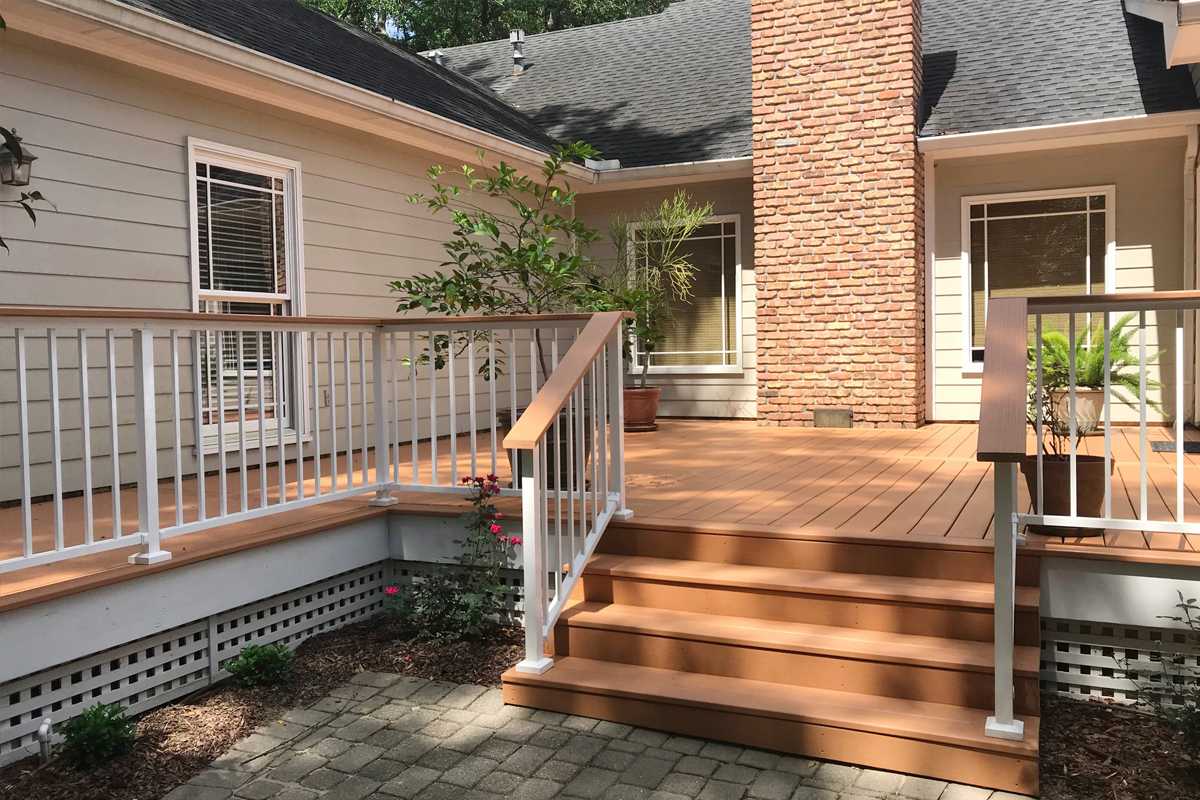
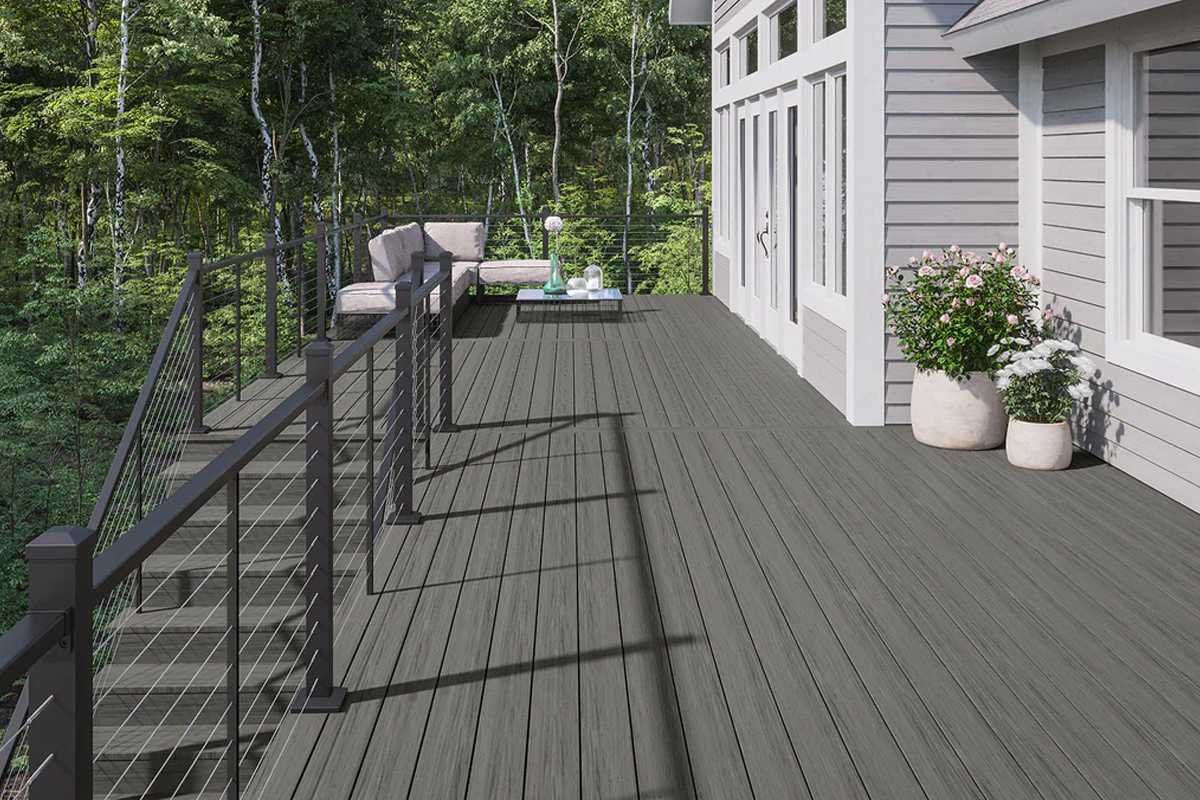

Deck Railings in Lenexa, KS

Your railing is the part of the deck everyone touches. Kids lean on it, guests rest drinks on it, and the inspector gives it a hard shove. We install deck railings in Lenexa that look clean, stay tight through hail season and freeze-thaw winters, and meet the Johnson County deck guidelines the city gives homeowners.

5.0 ⭐ rating with 250+ Google reviews, BBB A+ accredited since 2009, licensed Class A and residential contractor, Deckorators Certified Pro Spotlight builder, multi-year Angi Super Service and Best of Houzz award winner.

Deck Railings in Lenexa: What the Code Expects

The city points homeowners to the Johnson County residential deck guidelines, based on the 2018 IRC. Here’s what your railing has to do to pass:

  • When a guard is required: once the walking surface is more than 30 inches above the floor or grade below. That height is measured to the lowest grade within 36 inches horizontally of the open edge, so a deck on a falling slope can need a guard even when the yard right at the posts looks close.
  • Guard height: at least 36 inches from the deck surface to the top of the rail. On open sides of stairs with a total rise over 30 inches, the guard must be at least 34 inches measured straight up from the tread nosing.
  • Opening limits: a 4-inch sphere can’t pass between balusters, between cables, or under the bottom rail. The triangle formed by the riser, tread, and bottom rail on a stair can’t pass a 6-inch sphere.
  • Open risers: on stairs with more than 30 inches of total rise, the gap between treads also can’t pass a 4-inch sphere.
  • Top rail load: guards and handrails must resist a single 200-pound concentrated load applied in any direction at any point along the top.
  • Infill load: balusters, cables, mesh, or glass must resist a 50-pound load spread over one square foot, applied horizontally.
  • Stair handrails: required on at least one side of any flight with 4 or more risers. The rail runs continuously from directly above the top riser to directly above the bottom riser, sits 34 to 38 inches above the nosing, and returns to the post at both ends.
  • Graspable shape: a round handrail needs an outside diameter between 1-1/4 and 2 inches. A non-round rail needs a perimeter between 4 and 6-1/4 inches, no more than 2-1/4 inches across, with at least 1-1/2 inches of clearance from any wall or framing.
  • Lighting: the county guidelines call for an exterior light at the deck and lighting on the stairs.
  • Screens don’t count: insect screening is never accepted as a guard.

Good to know: stair and handrail mistakes are on the city’s own list of problems inspectors find most often. A wide, flat cap board on a stair is a common failure because a hand can’t wrap around it.

How a Railing Post Really Holds 200 Pounds

The post connection does the real work. A 200-pound lean on a 36-inch post pulls about 1,250 to 2,370 pounds on the top bolt, depending on rim joist size. Nails in end grain can’t hold that, which is why old rails wobble.

How we build against it:

  • 1/2-inch through-bolts on every post
  • Lags or blocking so the rim joist can’t twist
  • Hold-down hardware on tall or side-mounted posts
  • Galvanized or stainless hardware only

What Kansas Weather and Sloped Lots Do to a Railing

Most railing problems we see here trace back to a few causes:

  • Walkout heights: decks a full story up put more leverage on every post.
  • Wood movement: wet springs and dry winters loosen fasteners until the rim joist rolls.
  • Frost heave: piers shallower than 36 inches heave and throw rails out of line.
  • Corroded hardware: plain steel on treated lumber rusts right at the post connections.
  • Hail and wind: painted wood chips and splits; powder-coated aluminum holds its finish.
  • HOA rules: many associations approve railing color and style first. We supply the specs and samples.

Pick the Deck Railing System That Fits Your Yard

We’re a Westbury Certified Master Pro, so Westbury is our main deck railing system. We also install Deckorators, Fortress, DekPro, and RailFX when a project calls for them. See the full lineup on our railing products page.

Aluminum Deck Railing

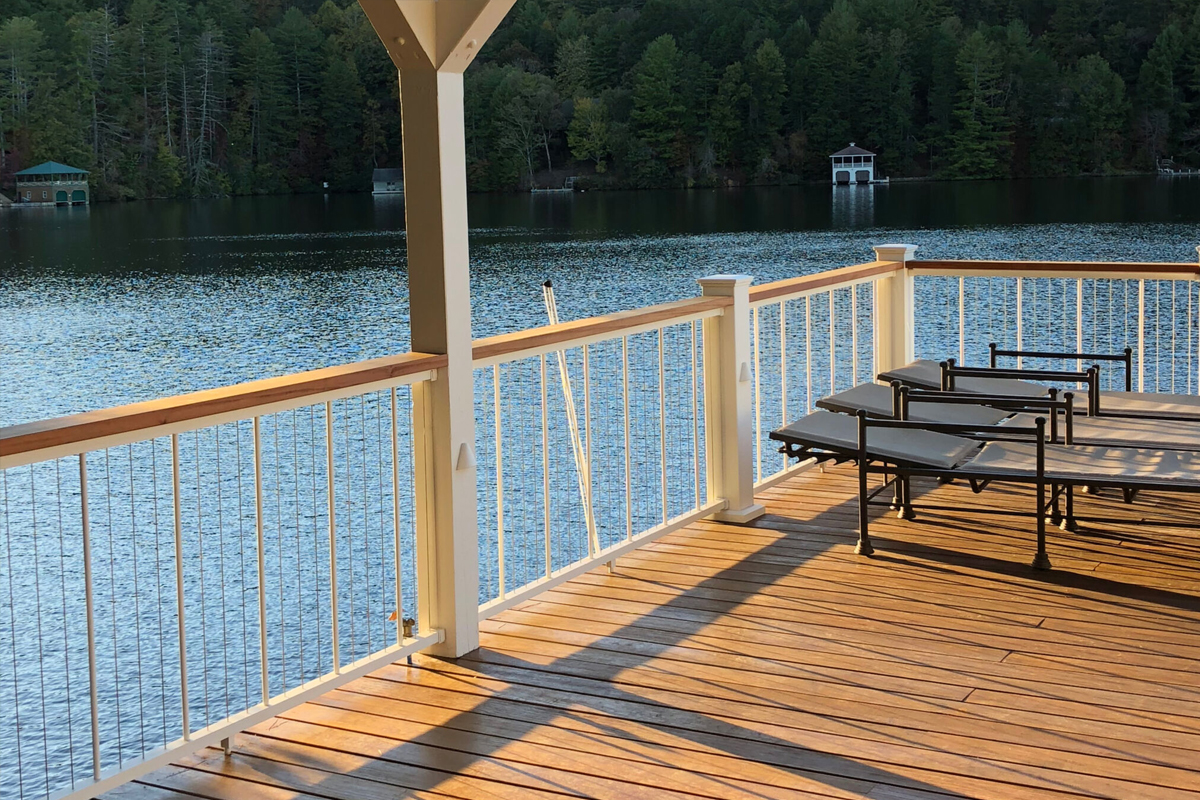
Aluminum is the workhorse for most homes. It doesn’t rot, swell or need staining, and a powder-coated finish resists rust and fading. Your options:

  • Tuscany: classic two-rail look with square balusters
  • Montego: curved balusters, with radius sections available for curved deck edges
  • Riviera: multi-rail profiles with square or round balusters for modern exteriors

Sections come pre-assembled or as kits, accept post lighting, and carry a lifetime limited warranty from Westbury. Aluminum posts don’t hold the load on their own. They need solid blocking under the deck boards or a reinforced rim, which is where most of our install time goes.

Cable Railing

Cable keeps the view open toward tree lines, ponds or a greenway. The tradeoff is engineering: tensioned cables pull hard on the end and corner posts, so those posts need stiff frames and solid connections.

  • VertiCable: vertical cables between a top and bottom rail, in pre-assembled aluminum sections. Many parents prefer it because it’s harder for kids to climb.
  • Bella Cavo: horizontal stainless steel cable in one-rail or two-rail designs for the most minimal look.

Cable has to keep the 4-inch sphere rule even when someone pushes on it, so spacers and tension both matter. Plan on a quick re-tension check after the first season as the cable settles.

Glass Deck Railing

Veranda uses tempered glass panels in an aluminum frame for a fully open view. On an exposed upper deck, glass also cuts the wind. Panels are heavier than balusters, so layout and post spacing get planned before ordering. Plan on wiping them down now and then to keep water spots and pollen off.

Mesh Railing

Sorrento uses welded stainless steel mesh in an aluminum frame. It keeps small dogs and toddlers in, lets air and light through, and installs as pre-assembled sections that work with other Westbury systems.

Stair Handrails, ADA Rails and Drink Rails

Stairs are where inspections fail most, so we size them right from the start: at least 36 inches wide, risers no taller than 7-3/4 inches, treads at least 10 inches deep, and no more than 3/8 inch of variation within a flight. The handrail goes on as a continuous, graspable rail with returned ends.

  • ADA aluminum handrail: for ramps, walkways, and family members who need a steady grip
  • Drink rail adapter: turns the top rail into a flat ledge topped with deck boards that match your floor

Mounting Styles

  • Surface mount: the post base bolts down through the decking into blocking below. Clean look, but the blocking has to be planned before the boards go on.
  • Fascia (side) mount: the post attaches to the face of the rim joist. It keeps more usable deck space but puts the most leverage on the rim, so it needs bolts, blocking, and often hold-downs.
  • Wood post with sleeve: a structural wood post wrapped in a matching sleeve, common with composite and some aluminum systems.

Other Brands We Install

When a project calls for a different look, we also install Deckorators, Fortress, DekPro, and RailFX. That includes composite-style railing that matches composite decking and black aluminum kits.

If your priority is… Look at
Keeping the view of trees or water Cable or glass
Kids or pets on the deck Mesh or vertical cable
A strict HOA or traditional brick exterior Tuscany or Montego in a trim-matching color
A modern exterior Riviera or Bella Cavo in a black finish
The least upkeep possible Any powder-coated aluminum system

Building a New Deck With Railing or Updating an Old One?

New deck: we plan the rails with the framing, so posts are blocked and bolted before decking goes down. Pair your railing with synthetic decking or wood decking, and see how we build the structure on our framing options page.

Existing deck with rails that wobble: a railing is only as strong as its framing, so we check that first:

  • Rim joist: thin 2×6 rims often need doubling or blocking.
  • Joist ends: we probe for rot where old posts were lagged in.
  • Ledger: it must be bolted and flashed, never just nailed.
  • Hardware: rusted or electroplated fasteners get swapped for galvanized or stainless.
  • Stairs: risers, treads, and handrail grip get checked to code.

Sound frame? We install the new system on fresh connections. Rot or a weak ledger? We show you photos first so you can choose repair or rebuild.

Permits: the city requires one for new decks, expansions, and framing repairs. We confirm whether your job needs one and handle it.

Decks and Railings Planned Together

Decks & railings look best when they’re designed as one project. A few pairings our clients ask about:

Why Homeowners Trust DW With Their Railing

  • Westbury Certified Master Pro with access to the full railing lineup
  • DW-trained crews who work for us year-round, with owner Dan Milford overseeing every job
  • Permits and inspections handled under our Class A Johnson County contractor license
  • 5-year craftsmanship and 5-year wood rot warranty on our work, on top of the manufacturer’s railing warranty
  • 5.0 stars from 260+ Google reviews. Clients often mention clear bids, no pressure to upsell, and clean job sites.
  • Building outdoor spaces since 1997 and BBB A+ accredited

How Your Railing Project Works

Share Your Vision Deck Railing

1. Share Your Vision

Tell us who uses the deck and what you want to see from it, from kids and dogs to the tree line out back. We measure height off grade at every open edge, check posts, rim joist, and stairs.

Design & Plan Deck

2. Design & Plan

We match a railing system to your budget, house, and HOA rules, then send an itemized bid. We handle the drawings, permit, and any HOA review. See every option on our railing products page.

Build & Enjoy Deck

3. Build & Enjoy

Our crew reinforces the frame, bolts every post solid, then installs the railing and stair rails to code. We walk the finished deck with you and show you what to check each year.

FAQs

How high does a deck have to be to need a railing?

A guard is required when the deck floor is more than 30 inches above grade, measured within 36 inches of the edge. Lower decks don’t need one, but any railing you add still has to be built safely.

How tall does a deck railing need to be?

The Johnson County guidelines call for at least 36 inches on the deck. Stair guards need 34 inches above the tread nosing, and stair handrails sit between 34 and 38 inches.

Do I need a permit to replace my deck railing?

The city requires permits for new decks, expansions, and repairs that change the framing. A railing swap may or may not fall under that, so we confirm with the building division before work starts.

How far apart can deck balusters be?

A 4-inch sphere can’t fit between balusters or under the bottom rail. Most code-listed aluminum systems are built to meet that spacing out of the box.

Is cable railing allowed on decks?

Yes, when the system keeps cable openings under 4 inches and holds the required loads. If climbing is a worry with young kids, vertical cable is a popular middle ground.

Do deck stairs need a handrail?

Any flight with 4 or more risers needs a handrail on at least one side. It has to be continuous, graspable, and returned at the ends.

Can you add a new railing to my existing deck?

Often, yes. We inspect the posts, rim joist, and ledger first, since a new railing is only as strong as the framing it’s bolted to.

What's the best deck railing for Kansas weather?

Powder-coated aluminum is the low-maintenance pick for most homes because it resists rust and fading. Cable and glass work well too if keeping the view matters most.

How much do deck railings cost?

Price depends on the system, linear footage, stairs, deck height, and extras like lighting. We give you an itemized bid after measuring on site.

Why does my deck railing wobble?

Usually the post connection has loosened or the rim joist is rolling outward under load. Nails and screws in joist end grain pull out over time, so the fix is through-bolts, blocking, and sometimes hold-down hardware.

Can aluminum railing go on a wood deck?

Yes. The aluminum posts bolt to solid wood blocking or a reinforced rim joist, which is what gives the railing its strength.

Ready for a Railing That Feels Solid?

See recent projects, browse pricing. Call (913) 782-7575 or request a bid, and we’ll help you choose the right deck railings in Lenexa for your home.

OUR ACCOLADES

Award Symbol

Granted a Class A building license for operation in Johnson County, Kansas. This is the top license type for any contractor.

Award Symbol

Deckorators chose DW Elite Decks as its First Certified Pro Spotlight Feature.

Award Symbol

Awarded the coveted Angie's List Super Service Award (many times), which is only given to the top 5% of all Kansas City deck builders.

Award Symbol

Nationally recognized by Rich Noonan, the Eight Time Emmy Award-Winning Reporter for Fox News!

Award Symbol

Westbury Certified Master Pro. Beacon of distinction as the bar is set high to earn this coveted status.

Our Service Image

Ensuring Quality and Compliance

At DW Elite Decks, we pride ourselves on delivering craftsmanship that meets and exceeds industry standards. As Kansas City’s premier custom deck builder since 1997, we ensure every project is executed with proper permits and passes final inspections, guaranteeing code compliance and long-term safety.

Our Service Image

Accolades