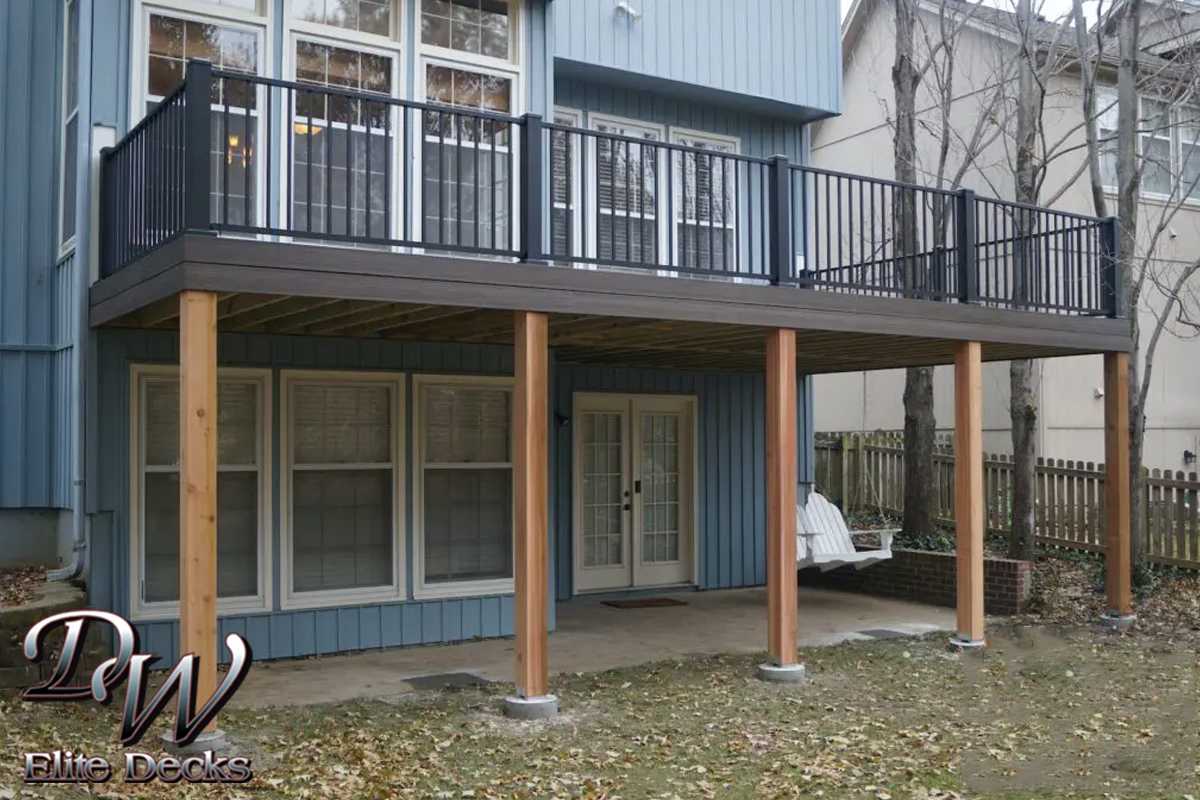

Tropical hardwood decks in Leawood, KS give you a surface hard enough to shrug off patio furniture, dog nails, and hail, with grain and color no composite board has quite managed to copy. Ipe runs olive to chocolate brown, cumaru leans golden red, tigerwood shows dark streaking across an orange background. All of it goes down over a frame built for Kansas clay and freeze-thaw, because hardwood decking only stays flat if what is underneath it does.
5.0 ⭐ rating with 240+ Google reviews, BBB A+ accredited since 2009, licensed Class A and residential contractor, Deckorators Certified Pro Spotlight builder, multi-year Angi Super Service and Best of Houzz award winner.
Leawood sits in a humid subtropical climate, which is a polite way of saying your deck gets soaked in May, baked in July, and frozen in January. Summer highs run near 89 degrees, winter lows drop into the low 20s, and the area picks up roughly 42 inches of precipitation a year. Real wood responds to all of it.
Here is what that means for a hardwood deck on your lot:
None of this makes hardwood a bad choice here. It just means the framing and the install matter as much as the species you pick.
Color is usually the first thing homeowners react to, so it helps to know what each species looks like new and what it looks like in year three. Tropical hardwood deck colors shift over time no matter what you do. The only question is whether you steer that change or let it happen.
Olive brown to deep chocolate with a tight, subtle grain. Roughly 3,680 on the Janka hardness scale, which is about three times harder than red oak. The most dent-resistant and longest lasting of the group, and the most expensive.
Golden tan through reddish brown, often with more visible grain movement than ipe. Nearly as hard as ipe at around 3,540, usually at a lower price. A strong middle ground for homeowners who want ipe performance without ipe pricing.
Orange brown with dramatic dark streaking, which is where the name comes from. Softer than ipe and cumaru but still far harder than any domestic decking wood. The most distinctive looking option, and the one that changes most visibly as it ages toward reddish brown.
Light golden yellow that mellows toward honey brown. The lightest option in both color and density. Good choice if a dark deck feels heavy against your siding, or if you want a surface that runs cooler in full sun.
Deep velvet red darkening toward reddish brown. Very dense and very striking. It is more sensitive to drying conditions than the others, so it needs careful sourcing and a longer acclimation window.
Every one of these woods will weather to a soft silver gray if you leave it alone. That is not damage, and it does not shorten the life of the deck. It is a legitimate design choice, and some homes look better for it.
If you want to hold the original tone, plan on cleaning the deck and applying a UV-protective penetrating oil about once a year. That is the real maintenance commitment with hardwood decking, and it is worth being honest with yourself about it before you choose the material.
Not sure hardwood is the right call? Our composite deck options include boards specifically designed to replicate an exotic hardwood look with no annual oiling. We are happy to price both so you can compare side by side, and you can see the full range on our decking options page.
This is the part of the job you never see once the furniture is out, and it is where hardwood decks either last or fail.
Footings below the frost line. Johnson County requires footings to reach at least 36 inches below grade. We pour piers sized for the load rather than setting precast blocks, and the footing inspection happens before anything gets framed.
One to two weeks of acclimation. Dense tropical species exchange moisture slowly. Your boards sit on site, stickered and covered, until they reach equilibrium with local humidity. Fastening them down before that is the single most common reason hardwood decks end up cupped and split.
Pre-drilling at every fastener. These woods are hard enough to split or snap a screw if you drive it straight in. Every hole gets drilled first.
Stainless steel hardware only. Standard fasteners react with the natural oils in tropical wood and leave black staining around every screw head within a season or two.
Gap spacing set on install day. Board gaps get set to the actual moisture reading of the wood that morning, not a fixed number, so the boards have room to move through a Kansas year.
Leawood has more process around outdoor projects than most metro cities, and we handle all of it. Here is what applies to your deck.
Permits. A building permit is required to construct a new deck, enlarge an existing one, or replace one. If you are only swapping decking boards and no structural members change, no permit is needed. Contractors must be licensed with both the City of Leawood and Johnson County.
Drawings. The city asks for a site plan and a deck plan, both drawn to scale, showing the deck location relative to the house along with property lines, easements, and dimensions. We produce these as part of the design, so you are not hiring a draftsman separately.
Setbacks. Most residential districts require at least a 25-foot rear yard setback and a 15-foot side yard setback. On some lots, that is the single biggest constraint on how deep the deck can be. Requirements vary by subdivision, so we confirm your specific lot with Codes Administration at 913-663-9165 before finalizing a footprint.
HOA approval. If your home sits inside the Leawood Homes Association in Old Leawood, or any other neighborhood association, that architectural review is a completely separate approval from the city permit. Getting a building permit does not mean your HOA has signed off, so we build that step into the schedule up front.
Inspections. Footing, framing, and final inspections are scheduled through the Access Leawood portal. Kansas 811 utility locates come before any digging.
Same three steps on every project. What changes is the detail inside them.
Bring a simple sketch, a saved photo, or nothing at all. We walk your yard, talk through species, board width, and layout, and you can see and feel the options at our Olathe showroom.
We create a custom design that fits your budget and your home, then handle the drawings, permits, and approvals covered above.
Our dedicated crew handles materials, construction and inspections, keeps you updated throughout, and walks the finished deck with you before we leave.
A hardwood deck pairs well with almost anything, and it is far cheaper to plan additions now than to retrofit later.
For maintenance timing through the year, our seasonal deck checklist is a useful reference once the deck is finished.
Yes. Building a new deck, enlarging an existing one, or replacing one all require a building permit from Leawood Codes Administration. If you are only swapping the decking boards and no structural members change, a permit is not required.
In many neighborhoods, yes. Associations such as the Leawood Homes Association in Old Leawood require Architectural Review Committee approval before construction, and that approval is separate from the city permit. Check your covenants early, because the review adds time to the schedule.
Most Leawood residential districts require at least a 25-foot rear yard setback and a 15-foot side yard setback. Requirements vary by subdivision, so confirm your specific lot with Codes Administration before finalizing a design.
Properly built and ventilated, ipe and cumaru decks commonly last 30 to 50 years or more, with some sources citing longer. The surface boards usually outlast the framing, which is why the substructure deserves as much attention as the wood on top.
It does if you leave it untreated, weathering to a silver gray patina over a year or two of sun exposure. This is cosmetic and does not affect durability. Annual cleaning and a UV-protective oil will hold the original brown tones.
Dark boards of any material warm up in direct summer sun, and darker species like Ipe and Massaranduba absorb more heat than lighter ones like Garapa. A covered deck or pergola makes the biggest difference if afternoon comfort is a priority.
Come see finishes in person at our Olathe showroom, take a look at our pricing guide to set expectations, or browse everything else we build on our Leawood deck builder page. When you are ready for a real number, we will walk your yard, talk through species and layout, and put together a detailed bid with no pressure attached.
Request your free bid or call (913) 782-7575 to start planning tropical hardwood decks in Leawood, KS.

Granted a Class A building license for operation in Johnson County, Kansas. This is the top license type for any contractor.

Deckorators chose DW Elite Decks as its First Certified Pro Spotlight Feature.

Awarded the coveted Angie's List Super Service Award (many times), which is only given to the top 5% of all Kansas City deck builders.

Nationally recognized by Rich Noonan, the Eight Time Emmy Award-Winning Reporter for Fox News!

Westbury Certified Master Pro. Beacon of distinction as the bar is set high to earn this coveted status.

At DW Elite Decks, we pride ourselves on delivering craftsmanship that meets and exceeds industry standards. As Kansas City’s premier custom deck builder since 1997, we ensure every project is executed with proper permits and passes final inspections, guaranteeing code compliance and long-term safety.