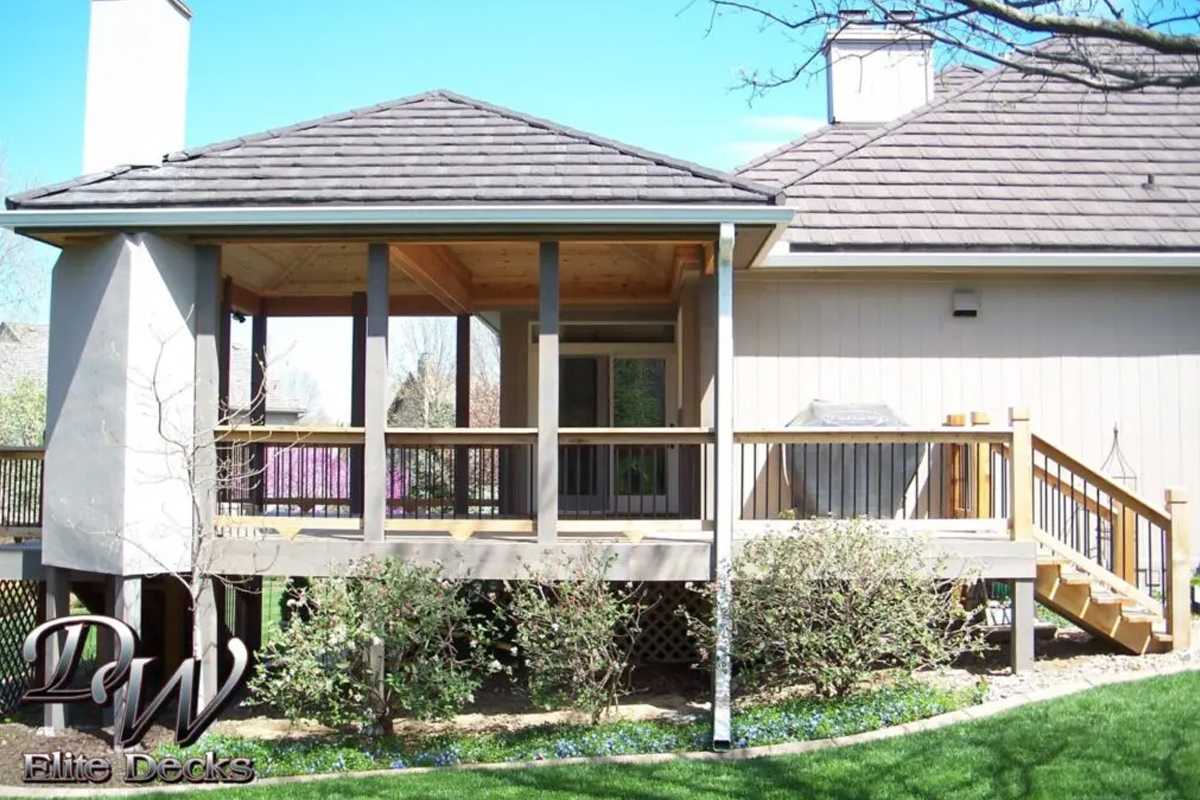
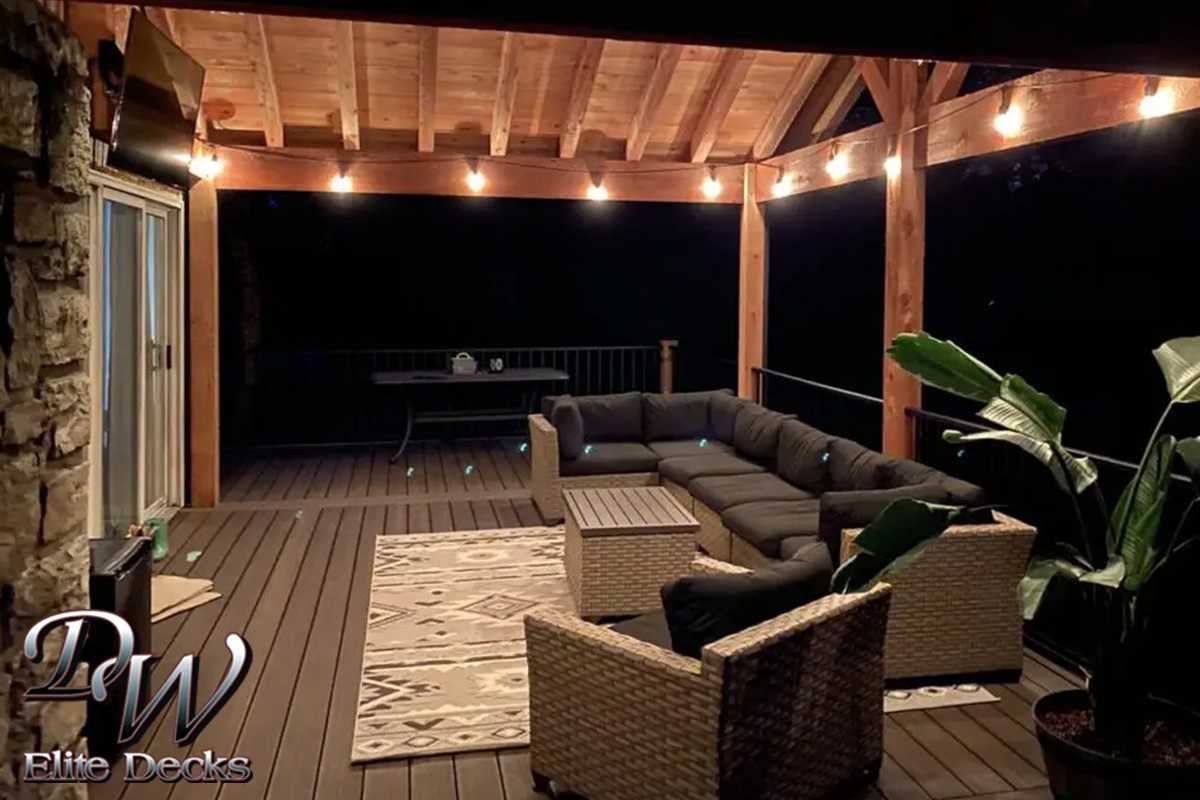
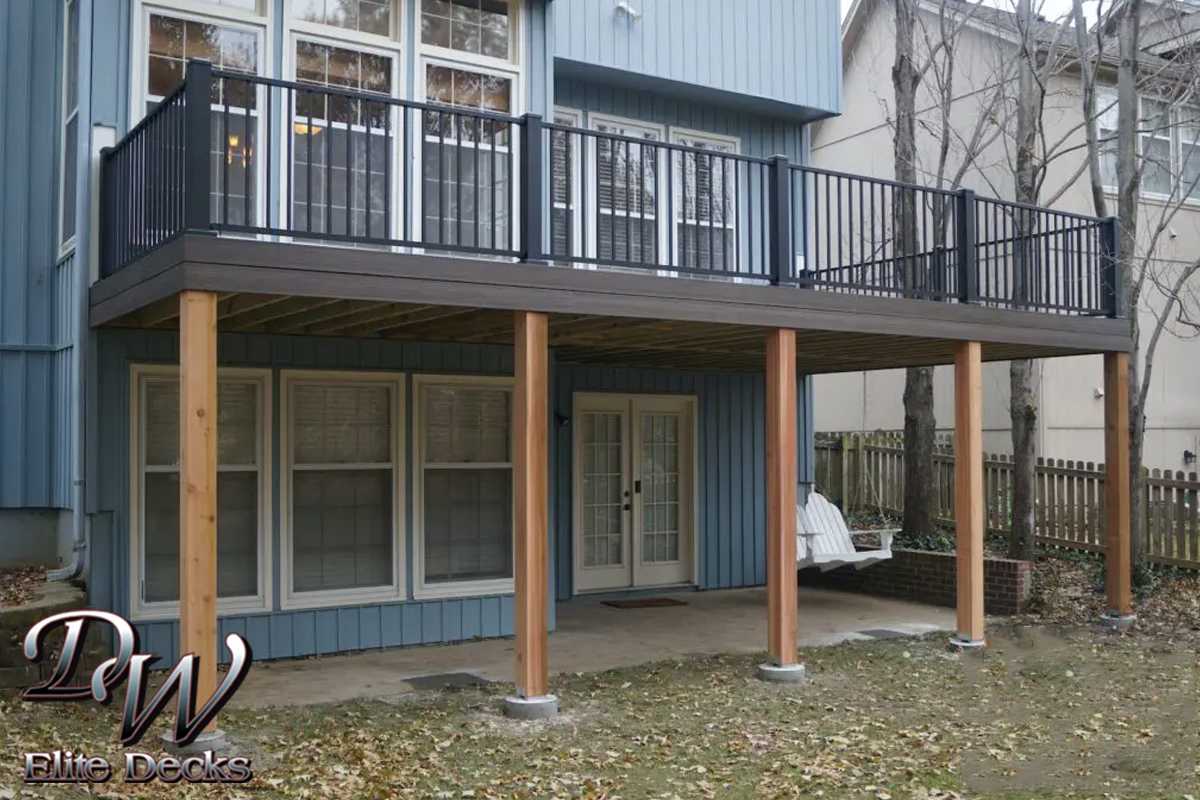

Most homeowners who call us about PVC & composite decks in Leawood, KS have already picked a color and a brand. The question they have not asked yet is the one that decides whether any of it lasts: what is holding it up?
Boards are the visible half of that decision. The frame underneath is what decides whether a 25-year board gives you a 25-year deck, and it is the part most quotes gloss over. We build both halves; we have since 1997, and we will tell you straight whether the frame you already have can carry a new surface or needs to come out.
5.0 ⭐ rating with 240+ Google reviews, BBB A+ accredited since 2009, licensed Class A and residential contractor, Deckorators Certified Pro Spotlight builder, multi-year Angi Super Service and Best of Houzz award winner.
Temperatures here run from about 24 degrees in January to 89 degrees in July, and winters here bounce above and below freezing constantly rather than settling into a hard freeze. Add roughly 42 inches of rain, most of it landing between April and June, and you get the two failure modes we see over and over on 20-year-old wood decks in town.
The first is the frame. Water gets into the joists, the ledger, and the post bases, then freezes and expands. Repeat that a hundred times a winter and the fasteners loosen and the wood rots from the inside. The second is the surface. Splinters, cupping, and a stain job that needs redoing every two or three summers.
Both PVC decks and composite decks solve the surface problem. Neither one solves the frame problem on its own, which is why the material conversation is only half of what we walk you through.
The difference is simple. Composite boards are a blend of plastic and wood fiber (or, in the newer mineral-based lines, plastic and mineral). PVC boards contain no organic material at all. Everything else follows from that.
Composite decking gives you a more convincing wood grain, a wider price range, and the widest selection of colors. Capped and mineral-based composites resist rot, mold, insects, and fading, and they clean up with soap and water. This is what most Leawood projects end up using.
PVC decking costs more per square foot and generally reads slightly less like real wood up close. What you get in return is a board with zero organic content, so there is nothing in it for moisture to act on. If your deck sits over a pool, wraps a spa, sits in deep shade under mature oaks where things stay damp, or has any section in direct ground or water contact, PVC earns its premium.
One myth worth clearing up: PVC is not automatically cooler underfoot. Board color drives surface temperature far more than material does. A dark PVC board will run hotter than a light composite board. If barefoot comfort matters, choose the color first and the material second, and come feel the samples in the sun at our Olathe showroom.
There is no single answer, but there is a good process. We ask how high the deck sits, how much afternoon sun it takes, whether kids or dogs will be on it daily, and how long you plan to stay in the house. Those four answers narrow four collections down to one pretty quickly.
Deckorators chose DW Elite Decks as its first Certified Pro Spotlight feature nationally, so it is the brand we know best and feature most. Worth knowing up front: every Deckorators decking line is composite, not PVC. Anyone telling you otherwise does not know the product.
| Collection | Best for | What sets it apart |
|---|---|---|
| Venture | Practical budgets | Scratch-resistant polyethylene cap, dense composite core, capped on three sides |
| Summit | The balanced upgrade | Surestone mineral-based core, roughly 35% lighter, textured for wet-weather grip |
| Vista | Style-driven designs | Exotic hardwood look, ASTM E84 Class B fire-rated core |
| Voyage | Premium builds | Up to 34% more traction, micro-embossed to reduce heat, approved for ground and water contact |
Venture, Summit, and Vista each carry a 25-year structural warranty and a 25-year stain and fade warranty, while the Voyage line has a 50-year structural warranty. Compare the full Deckorators lineup here.
When a project calls for the best PVC decking instead, we install AZEK and TimberTech. We also work with Fiberon, Envision, and Trex. If you already have a brand in mind from a neighbor’s build, bring it to us, and we will price it honestly against the alternatives.
Leawood’s Codes Administration Division reviews plans, issues permits, and inspects the work. A few local specifics that affect your project and your budget:
A resurface may not need a permit. A rebuild does. If you are only swapping the decking material and leaving the structure alone, Leawood does not require a permit. The moment a joist, beam, or post gets replaced, you need one. This matters because a lot of the “just put composite on top of my old frame” quotes floating around town skip a structural evaluation that should have happened.
Setbacks are generous here. Most residential districts require the deck to sit at least 25 feet from the rear property line and 15 feet from the side. Your subdivision may be stricter. On tighter lots this is the constraint that shapes the footprint, and it is worth confirming before you fall in love with a design.
Plot plans usually need a seal. Submittals typically require plot plans signed and sealed by a Kansas-registered civil engineer or land surveyor.
Footings go 36 inches down. Johnson County requires footings below the frost line at a minimum of 36 inches. Poured-in-place piers at proper depth are what keep a deck level through winter after winter of freezing and thawing. Shallow footings heave, and heaved footings rack the frame and tear at the ledger.
Two licenses, not one. Contractors have to be licensed with both the City of Leawood and Johnson County. Ask any bidder to show you both.
North of I-435? Those properties are subject to Johnson County Wastewater approval, which adds a step to the timeline.
We handle all of this. You do not chase City Hall.
Same three steps on every project. What changes is the detail inside them.
Bring a sketch, a photo off Pinterest, or nothing at all. We walk your property first and look at sun exposure, grade, drainage, tree cover, and access, because those five things narrow the material list faster than anything you will read online. Wooded estate lots in Highlands Creek or the Hills of Leawood raise different questions than the flatter, established lots north of I-435.
You see real boards, not a brochure. We bring samples to you, or you come to the showroom; we explain the trade-offs, and you decide with no push toward the expensive option. From there, you get a custom design built around your budget and an itemized bid, line by line, so you can adjust before anything is ordered. We also prepare the permit application, plot plan, setback verification, and any HOA architectural review submittal.
Footings first, then frame, then surface. Our dedicated crews do the work; we clean the site at the end of each day, and you hear from us as the job moves rather than having to chase us. The final inspection sign-off goes in your file when we finish.
Most homeowners we meet want more than a deck surface. A few pairings worth considering while the design is still on paper, since retrofitting later always costs more:
Composite decks start around $20,000 with most projects landing between $25,000 and $40,000, or roughly $100 to $160 per square foot. See the full pricing breakdown.
Yes. Building, enlarging, modifying, or replacing a deck all require a permit from Leawood’s Codes Administration Division. We prepare and submit the application as part of your project.
No. If you are swapping the decking material and leaving the structure untouched, no permit is required. If any joist, beam, or post gets replaced, a permit is required.
Both handle it well. Composite is the more common choice and offers better value for most yards, while PVC is worth the premium in wet locations like pool surrounds, shaded areas, or anywhere with ground contact.
Most projects run $25,000 to $40,000, or about $100 to $160 per square foot. Height off the ground, stairs, railing upgrades, and site access move that number the most.
A minimum of 36 inches below grade, which puts them below the frost line. This is what prevents frost heave from lifting and racking the deck over successive winters.
Color matters more than material. Lighter boards stay noticeably cooler than dark ones, and lines like Deckorators Voyage use a micro-embossed finish to reduce heat retention.
Deckorators collections carry 25-year structural and 25-year stain and fade warranties, and properly installed composite regularly lasts decades. The frame underneath is usually what determines real lifespan.
Sometimes, but only after we inspect it. We check ledger attachment, joist spacing, and post condition first, because premium boards over a failing frame are money wasted.
Come see the boards in person at our Olathe showroom, or have us out to walk your yard and put together an itemized bid. There is no charge and no pressure. Whether you have already settled on a material or you are still comparing options, we will give you a straight answer about what will actually work on your lot.
DW Elite Decks has been building outdoor living spaces across Southern Johnson County since 1997, and we would be glad to be the team you trust with your PVC & composite decks in Leawood, KS.

Granted a Class A building license for operation in Johnson County, Kansas. This is the top license type for any contractor.

Deckorators chose DW Elite Decks as its First Certified Pro Spotlight Feature.

Awarded the coveted Angie's List Super Service Award (many times), which is only given to the top 5% of all Kansas City deck builders.

Nationally recognized by Rich Noonan, the Eight Time Emmy Award-Winning Reporter for Fox News!

Westbury Certified Master Pro. Beacon of distinction as the bar is set high to earn this coveted status.

At DW Elite Decks, we pride ourselves on delivering craftsmanship that meets and exceeds industry standards. As Kansas City’s premier custom deck builder since 1997, we ensure every project is executed with proper permits and passes final inspections, guaranteeing code compliance and long-term safety.